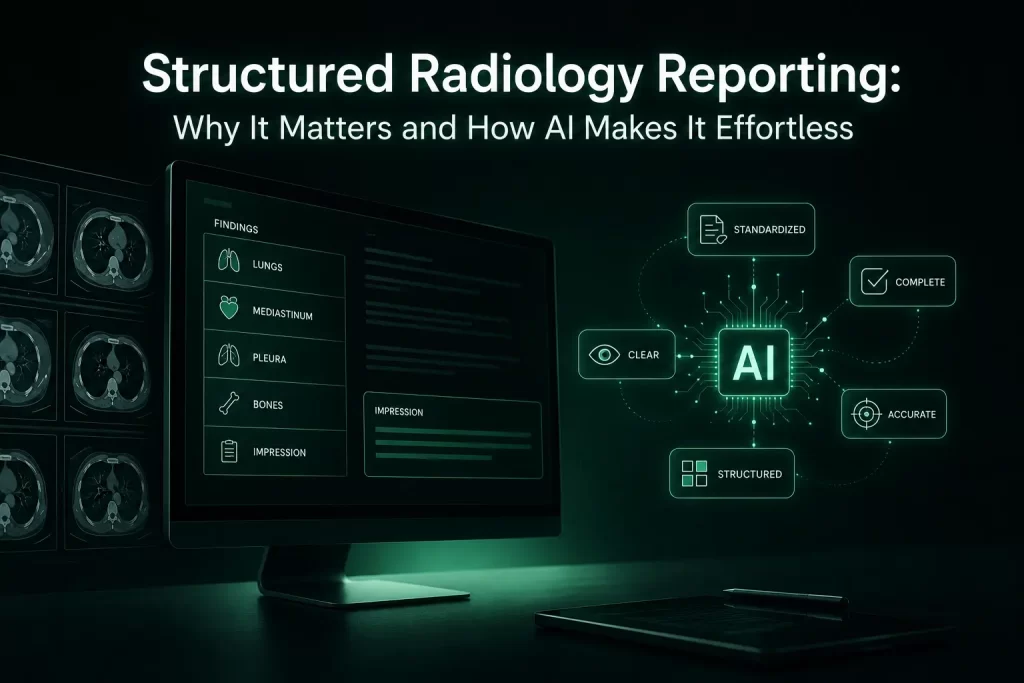
Structured Radiology Reporting: Why It Matters and How AI Makes It Effortless

Ask a referring clinician what they need from a radiology report, and the answer is consistent across specialties: clarity, structure, and completeness. They need to know what was found, where it is, how significant it is, and what it may mean for the patient — without having to parse through variable prose styles, inconsistent terminology, or free-text paragraphs that bury the clinical conclusion.

Structured radiology reporting exists to provide exactly that. And yet, despite decades of advocacy from the American College of Radiology, the Radiological Society of North America, and clinical researchers worldwide, structured reporting remains inconsistently adopted across teleradiology and hospital radiology environments.

Structured Radiology Reporting Why It Matters and How AI Makes It Effortless

In 2026, AI is changing that equation. What was previously a standard that required significant radiologist time and effort to maintain consistently is becoming something closer to the default — the automatic output of AI-assisted reporting systems that structure findings in real time, as the radiologist reads.

This piece examines what structured radiology reporting is, why it matters clinically and operationally, what has prevented widespread adoption, and how AI — particularly voice-driven AI reporting tools like RadNeo — is making structured reporting effortless at scale.

What Is Structured Radiology Reporting?

Structured radiology reporting is the practice of generating radiology reports using predefined templates, standardised terminology, and a consistent organisational format — as opposed to the traditional free-text narrative approach where each radiologist dictates a report in their own words and style.

The Nature Index defines structured reporting as the use of predefined templates and standardised language to generate imaging reports that are complete, consistent, and machine-readable.

The Key Characteristics of a Structured Report

Structured reports reduce ambiguity, ensure that all pertinent observations are addressed, and facilitate communication between radiologists, clinicians and other stakeholders. The approach supports automated data extraction and downstream clinical applications. — Nature Index, 2025–2026

Why Structured Reporting Matters: The Clinical and Operational Case

1. Improved Clinical Communication

The primary purpose of a radiology report is to communicate diagnostic findings to a referring clinician in a form they can act on. Structured reports do this more effectively than free-text narratives — the organisation is predictable, the terminology is consistent, and the impression is immediately identifiable. Referring clinicians do not have to read the entire report to locate the clinical conclusion; it is always in the same place.

In emergency settings, where speed of communication is critical, this predictability has direct clinical value. A structured stroke report that places the key finding — haemorrhage present or absent, location, size — in a standardised impression section is faster to act on than an unstructured narrative that buries the same information in the fourth paragraph.

2. Reduced Diagnostic Ambiguity and Error

Unstructured free-text reports introduce variability in how findings are described, measured, and contextualised. The same anatomical finding might be described with different terminology by different radiologists, or with varying degrees of clinical emphasis. Structured reporting reduces this variability by standardising how findings are expressed — reducing the risk that a clinically significant finding is underemphasised or ambiguously communicated.

Research has consistently documented that structured reporting reduces omission errors — the failure to address a relevant clinical question — by prompting radiologists through the required sections systematically.

3. Better Data for the Healthcare System

Structured reports are machine-readable in ways that free-text reports fundamentally are not. As healthcare systems invest in population health analytics, clinical decision support, and AI-based diagnostic tools, the value of structured, parseable radiology data becomes increasingly significant.

A radiology department that has been generating structured reports consistently for three years has a data asset that a department using free-text reports does not — a queryable, consistent record of imaging findings that can support research, quality improvement, outcome analysis, and AI model training.

4. Consistent Quality Across Distributed Teams

For teleradiology networks — where studies are read by a distributed team of radiologists across different locations, time zones, and specialties — maintaining consistent report quality is one of the most persistent operational challenges. Structured reporting addresses this directly. When every radiologist in the network uses the same template and terminology, the output is consistent regardless of which individual produced the report.

This consistency matters not just for quality, but for the clinical relationships that teleradiology operations depend on. Referring clinicians and hospital partners form judgements about a teleradiology provider's quality based on the reports they receive. Consistent structure signals consistent quality.

5. Support for Accreditation and Peer Review

Structured reports are more amenable to peer review and quality assurance processes than free-text reports. The standardised format makes it easier to identify discrepancies, omissions, and terminology inconsistencies during QA review. For facilities pursuing radiology accreditation, the ability to demonstrate reporting consistency is a meaningful advantage.

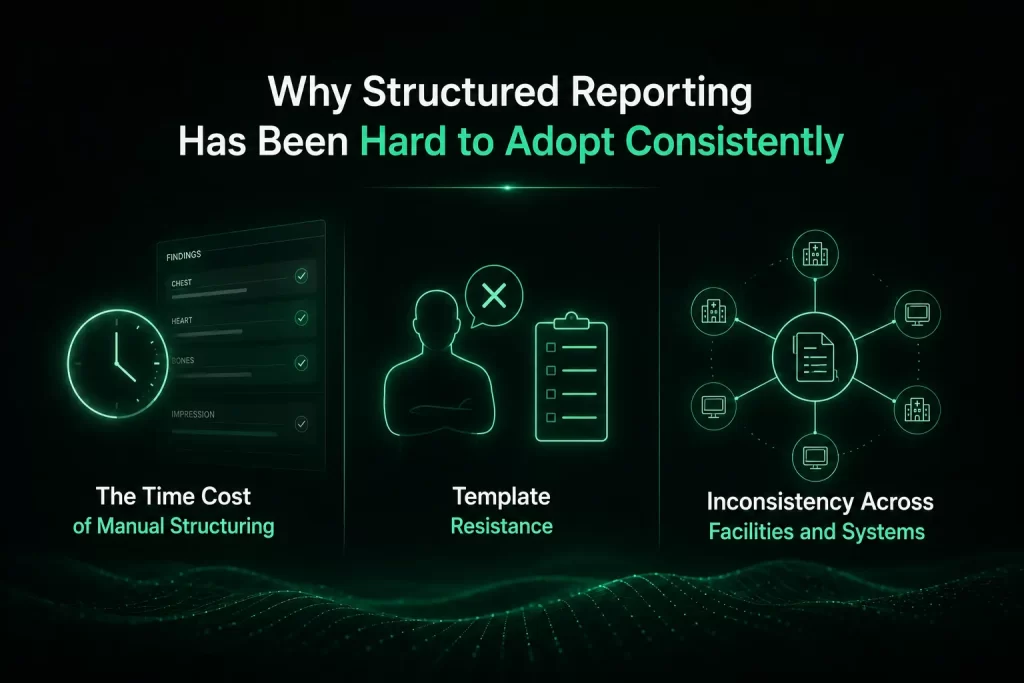
Why Structured Reporting Has Been Hard to Adopt Consistently

Why Structured Reporting Has Been Hard to Adopt Consistently

Despite strong support from the ACR and RSNA, structured reporting has historically been more aspirational than universal in practice. The reasons are largely operational.

The Time Cost of Manual Structuring

In a traditional dictation workflow, asking a radiologist to structure their report manually — navigating a template, ensuring each section is completed, maintaining consistent terminology — adds meaningful time to each read. In high-volume environments where a radiologist is reading 80 to 200 studies per shift, this time cost compounds across every study and becomes a significant barrier to adoption.

Template Resistance

Radiologists trained in free-text dictation often resist the transition to template-based reporting, viewing it as a constraint on their natural reporting style. Poorly designed templates that fragment related findings into disconnected subcategories can genuinely reduce the quality and coherence of a report — creating legitimate clinical objections to structured reporting adoption.

Inconsistency Across Facilities and Systems

Teleradiology networks reading for multiple facilities often encounter different structural requirements from different clients — different templates, different terminology preferences, different impression formats. Managing this complexity in a high-volume environment without AI assistance has historically required either a lowest-common-denominator approach or significant manual effort.

Poorly designed templates can fragment related processes into subcategories, disrupt cohesive synthesis, and hinder comprehensive understanding, especially in multi-compartmental pathological conditions. — Journal of Radiology Research, 2024

How AI Makes Structured Reporting the Effortless Default

The advent of AI-powered voice reporting tools has fundamentally changed the structured reporting adoption equation. The core barrier — that structuring takes more time than free-text dictation — is eliminated when the AI handles the structuring automatically.

Voice-Driven AI Reporting: Dictate Naturally, Receive Structured Output

Modern AI reporting tools allow radiologists to dictate their findings in natural speech — exactly as they would in a traditional free-text workflow — while the AI converts that dictation into a structured, formatted report in real time. The radiologist does not navigate a template, fill in sections manually, or reformat their natural language output. They simply read and dictate; the AI does the structural work.

The result is that structured reporting stops being a process that requires additional effort and becomes the default output of the radiologist's existing workflow. There is no time cost. There is no disruption to natural dictation style. There is simply a structured report where an unstructured one would have been produced before.

Context-Aware Intelligence: Beyond Transcription

The most capable AI reporting systems go beyond converting speech to structured text. They bring contextual clinical intelligence to the structuring process — understanding which anatomical region is being described, what the relevant clinical context is, and how findings should be organised within the report to maximise clinical utility.

This is the difference between AI that transcribes structured format and AI that understands what it is structuring. Knowledge graph–driven systems — like those underpinning RadNeo — maintain a representation of radiology intelligence that informs how findings are organised, how terminology is standardised, and how the impression is constructed from the dictated findings.

Global Reporting Adaptability

For teleradiology networks reading for multiple facilities with different reporting requirements, AI-powered structured reporting provides a significant operational advantage. A well-designed AI reporting system can adapt its output format to match the structural requirements of each facility — automatically applying the correct template, terminology conventions, and impression format for each client — without requiring the radiologist to manage that complexity manually.

Real-Time Quality Assurance

AI reporting systems can also perform real-time quality checks during the reporting process — flagging missing sections, inconsistent terminology, or findings that appear clinically incomplete. This embedded quality assurance reduces the likelihood of omission errors and supports peer review processes without requiring a separate post-reporting review step.

RadNeo by UEVOLVEAi: Structured Reporting Built Into the Workflow

RadNeo by UEVOLVEAi Structured Reporting Built Into the Workflow

RadNeo is UEVOLVEAi’s AI-powered reporting system, designed to make structured radiology reporting the default output of every read — without changing how radiologists work.

RadNeo was built around a simple principle: structured reporting should not require more effort than unstructured reporting. With AI handling the structure, the radiologist focuses entirely on the interpretation.

To see RadNeo in action and explore how AI-powered structured reporting can transform your teleradiology workflow, request a demo or contact the UEVOLVEAi team.

What the Research Shows: The Evidence for Structured Reporting

Frequently Asked Questions

What is the difference between structured and unstructured radiology reports?

Unstructured (free-text) reports are dictated in narrative prose, with each radiologist using their own organisational approach and terminology. Structured reports use predefined templates, standardised terminology, and consistent section organisation — ensuring that every report contains the same information in the same format, regardless of who produced it. Structured reports are more clinically clear, less ambiguous, and machine-readable in ways that free-text reports are not.

Does structured reporting slow radiologists down?

Traditionally, manually navigating a template added time to each report. With AI-powered voice reporting tools like RadNeo, this time cost is eliminated. The radiologist dictates naturally; the AI applies the structure automatically. Peer-reviewed research has documented 30–50% faster report generation with AI-assisted structured reporting compared to traditional unstructured dictation workflows.

What is a radiology report template?

A radiology report template is a predefined document structure that organises a radiology report into standardised sections — typically including indication, technique, comparison, findings (organised anatomically), impression, and recommendations. Templates ensure completeness by prompting radiologists to address each relevant clinical section, and they standardise the format so referring clinicians know exactly where to find each type of information.

How does AI improve radiology report quality?

AI improves radiology report quality in several ways: by converting natural dictation into consistently structured output, by standardising terminology across a distributed team, by flagging missing sections or clinically incomplete findings in real time, by performing automated quality checks before report sign-off, and by applying context-aware clinical intelligence to ensure that the impression accurately reflects the significance of the findings.

What is RadNeo?

RadNeo is UEVOLVEAi's AI-powered workflow intelligence system for radiology reporting. It enables voice-driven structured reporting — converting natural dictation into structured, formatted reports in real time — and operates within the radiologist's existing PACS environment without requiring additional screens or platforms. RadNeo uses a knowledge graph approach to clinical intelligence, ensuring that structured outputs are not just fast, but clinically accurate and contextually appropriate.

Is structured reporting supported by ACR and RSNA?

Yes. Both the American College of Radiology and the Radiological Society of North America have been strong advocates for structured radiology reporting for over a decade. ACR has published reporting templates across multiple subspecialties and clinical scenarios, and RSNA's RadReport initiative provides a library of standardised reporting templates. The 2026 governance and standards focus from both organisations explicitly includes AI-assisted structured reporting as a priority area.

Conclusion

Structured radiology reporting has been an aspirational standard for decades. The clinical benefits are unambiguous — better communication, reduced diagnostic ambiguity, machine-readable data, consistent quality across distributed teams, and stronger support for QA and accreditation. The barrier has always been the operational cost: the time and effort required to structure reports manually in high-volume environments.

AI has removed that barrier. Voice-driven AI reporting tools that convert natural dictation into structured output in real time make structured reporting the default — not a standard that requires additional effort to maintain, but the automatic outcome of the radiologist’s existing workflow.

For teleradiology networks, hospital radiology departments, and imaging centers that want to deliver consistently structured, high-quality reports without adding to the burden on their radiologists, AI-powered structured reporting is not a future aspiration. It is available now.

RadNeo by UEVOLVEAi makes structured radiology reporting the effortless default for every read. Explore RadNeo or contact our team to see how it works in practice.