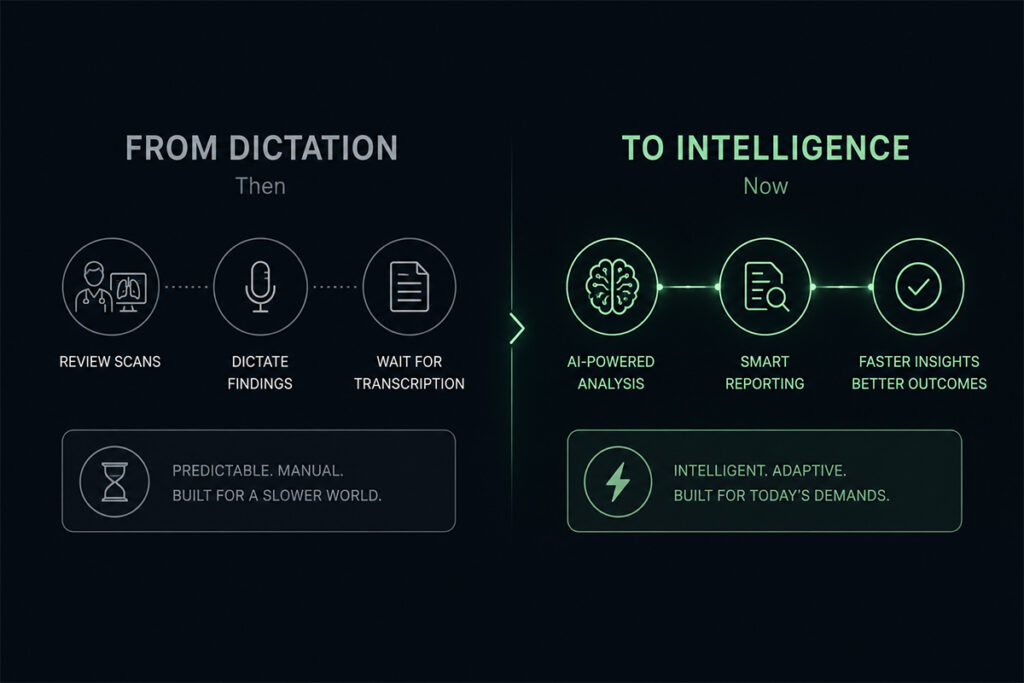
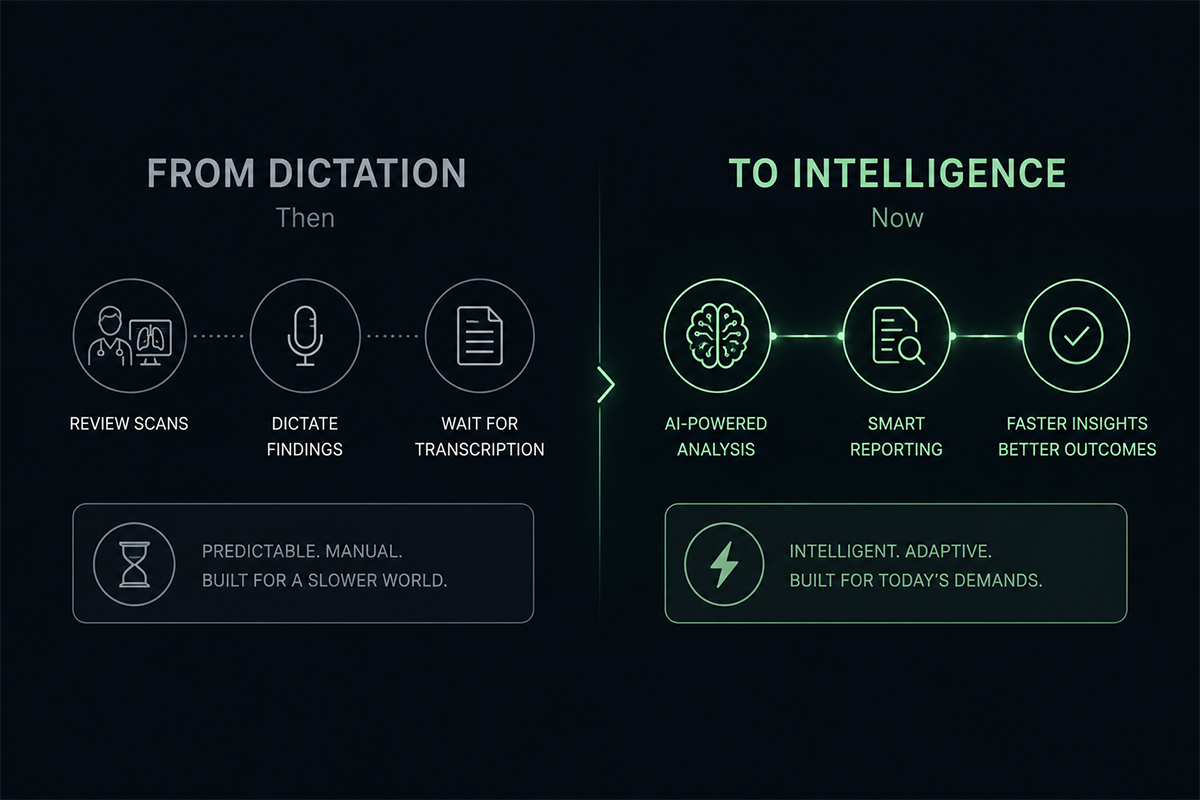
For decades, radiology reporting followed the same fundamental path. A radiologist reviewed scans, dictated findings, and waited for transcription. The workflow was predictable — but it was also slow, manual, and built for a world where scan volumes were manageable and turnaround expectations were forgiving.
That world no longer exists.
Today, teleradiology operates in an environment defined by high case loads, tight reporting windows, and the expectation of near-instant results — often across multiple geographies, systems, and time zones. The tools that once got the job done are no longer keeping up. What radiology needs now is not just faster dictation. It needs intelligence
How Radiology Reporting Has Changed Over the Decades
The journey from dictation machines to AI-assisted workflows did not happen overnight. In the early days, radiologists spoke their findings into tape recorders, and typists transcribed those recordings into formal reports. It was slow and error-prone, but it worked within the pace of the time.
Digital dictation improved speed but did not fundamentally change the structure. Speech-to-text software reduced transcription delays, yet radiologists were still doing the cognitive heavy lifting entirely on their own — organizing observations, comparing prior studies, structuring reports — without any systemic support.
The real shift began when radiology moved into networked, cloud-connected ecosystems. Suddenly, a single radiologist could be reading scans from hospitals across different cities or even countries. Volume increased. Complexity grew. And the old model began to crack under the weight.
Built for the Modern Teleradiology Ecosystem
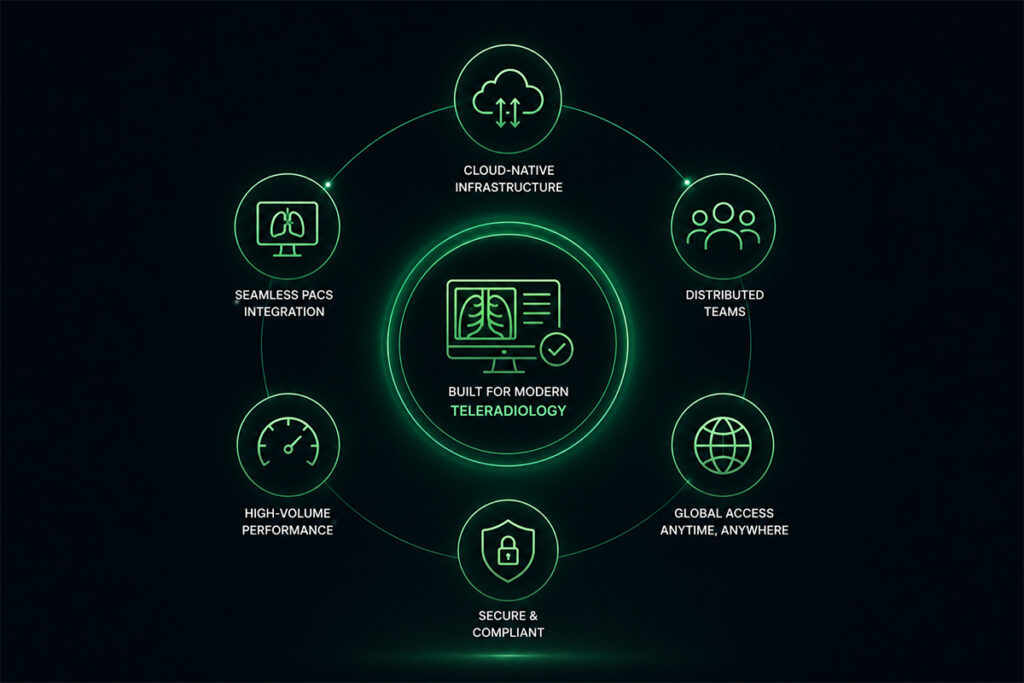
The infrastructure of teleradiology today is fundamentally different from what it was even five years ago. Reporting no longer happens in a single room with a single PACS terminal. It happens across distributed teams, remote setups, cloud-based platforms, and on-call networks that span time zones.
This shift demands tools that are not just digitized versions of old workflows, but systems designed from the ground up for how modern teleradiology actually functions. That means seamless integration with existing PACS environments, the ability to handle high-volume queues without performance degradation, and reporting infrastructure that moves as fast as the radiologist reading the case.
A truly modern teleradiology platform does not ask radiologists to adapt to its limitations. It adapts to theirs.
AI-Powered Teleradiology: More Than Automation
When most people hear “AI in radiology,” they think of detection algorithms — systems that flag nodules, measure lesions, or screen for abnormalities. That is one piece of the picture. But AI-powered teleradiology goes further.
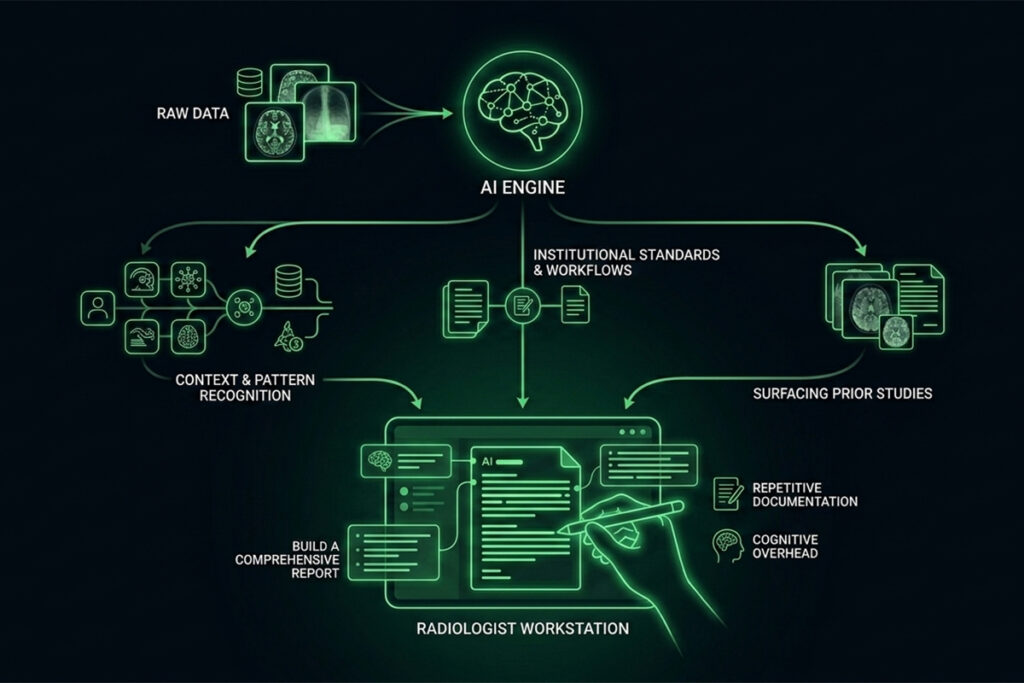
Intelligence in this context means understanding the context of a report, not just its content. It means recognizing patterns in how a particular radiologist structures their findings, learning the reporting standards of a specific institution, and surfacing relevant prior studies before the radiologist even asks. It means reducing the cognitive overhead of repetitive documentation so that the radiologist’s attention stays where it matters most — on the clinical interpretation.
AI-powered reporting tools are not replacing radiologist judgment. They are removing the friction that surrounds it.
Intelligence That Works the Way Radiologists Do
One of the most persistent failures of early radiology software was that it forced radiologists to work around the tool rather than with it. Templates were rigid. Integrations were clunky. Workarounds became standard practice.
Intelligent reporting changes that dynamic. Instead of requiring radiologists to conform to a fixed structure, the system learns from how each radiologist works — their terminology, their phrasing preferences, the way they organize complex multi-finding reports. Over time, the tool becomes an extension of the radiologist’s own cognitive style rather than an obstacle to it.
This is what it means for intelligence to work the way radiologists do: not imposing a new workflow, but augmenting an existing one with speed, consistency, and contextual awareness.
Our First Step Toward Workflow Intelligence
Building truly intelligent radiology reporting is not a single leap — it is a series of deliberate steps. The first step is understanding where friction lives in the current workflow. Where are radiologists losing time? Where are errors most likely to occur? Where does the reporting process create bottlenecks that delay turnaround and affect patient care?
The answer to those questions shapes what workflow intelligence actually looks like in practice. It might mean smart auto-population of routine findings, reducing keystrokes for common report types. It might mean automatic linkage between current and prior studies, so comparison is immediate rather than manual. It might mean intelligent queue management that prioritizes urgent cases without requiring manual sorting.
Each of these is a step. Together, they represent a fundamentally more efficient way to report.
Who This Is Built For
Radiology has always required precision. What it now also requires is pace — and intelligence is the only way to deliver both without burning out the people at the center of it.
Frequently Asked Questions