How AI Is Transforming Teleradiology Workflows Across Healthcare Systems in 2026

For the better part of three decades, teleradiology solved one problem well: moving images from where patients were to where radiologists were. The infrastructure improved — faster PACS systems, better encryption, higher bandwidth — but the core workflow remained fundamentally unchanged. A radiologist opened a study, read the images, dictated a report, and sent it back.

In 2026, that model is being replaced by something more intelligent.

Artificial intelligence is no longer a pilot programme or a research curiosity in radiology. It is being actively integrated into teleradiology workflows at scale — changing how studies are triaged, how reports are structured, how critical findings are surfaced, and how radiologists spend their clinical time.

This piece examines exactly how AI is transforming teleradiology workflows, what the clinical evidence shows, how to evaluate AI solutions as a healthcare leader, and what intelligent, workflow-embedded AI actually looks like in practice.

The Problem AI Is Actually Solving

To understand what AI is changing, it helps to start with what was broken.

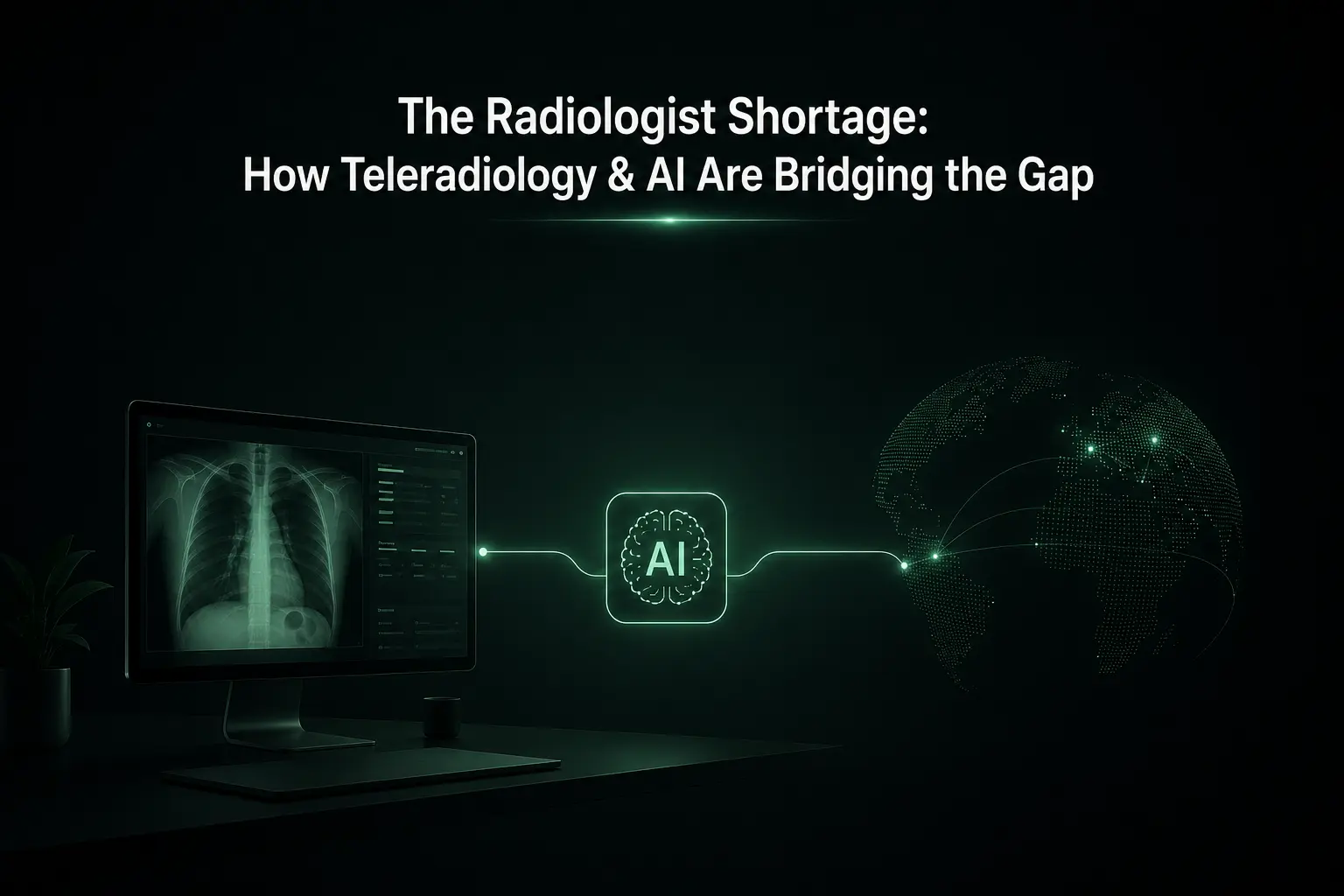
Radiology is facing a compound crisis. Scan volumes are growing at approximately 15% annually. The radiologist workforce is growing at around 2%. That gap produces a set of downstream pressures that have nothing to do with diagnostic skill and everything to do with workflow:

The fundamental challenge is not detection. It is workflow. Radiologists are not failing to find abnormalities — they are being buried in the operational overhead of documenting, structuring, and managing the process around the interpretation.

This isn't a reading problem. It's a workflow problem. And AI is solving the right problem.

How AI Is Transforming Each Stage of the Teleradiology Workflow

1. Intelligent Worklist Triage

In a traditional teleradiology workflow, studies arrive in a worklist roughly in the order they were completed. In a high-volume environment, a time-critical stroke study could sit behind a stack of routine outpatient CTs.

AI-powered triage systems analyse incoming studies and automatically prioritise urgent cases — flagging potential strokes, pulmonary embolisms, intracranial haemorrhages, and pneumothoraces for immediate review. The radiologist's worklist is reordered in real time based on clinical urgency, not arrival time.

This change alone has measurable clinical consequences. In stroke care, every minute of delayed treatment increases the likelihood of lasting disability. AI triage ensures that the cases requiring the fastest response are at the top of the list, always.

2. AI-Assisted Report Generation

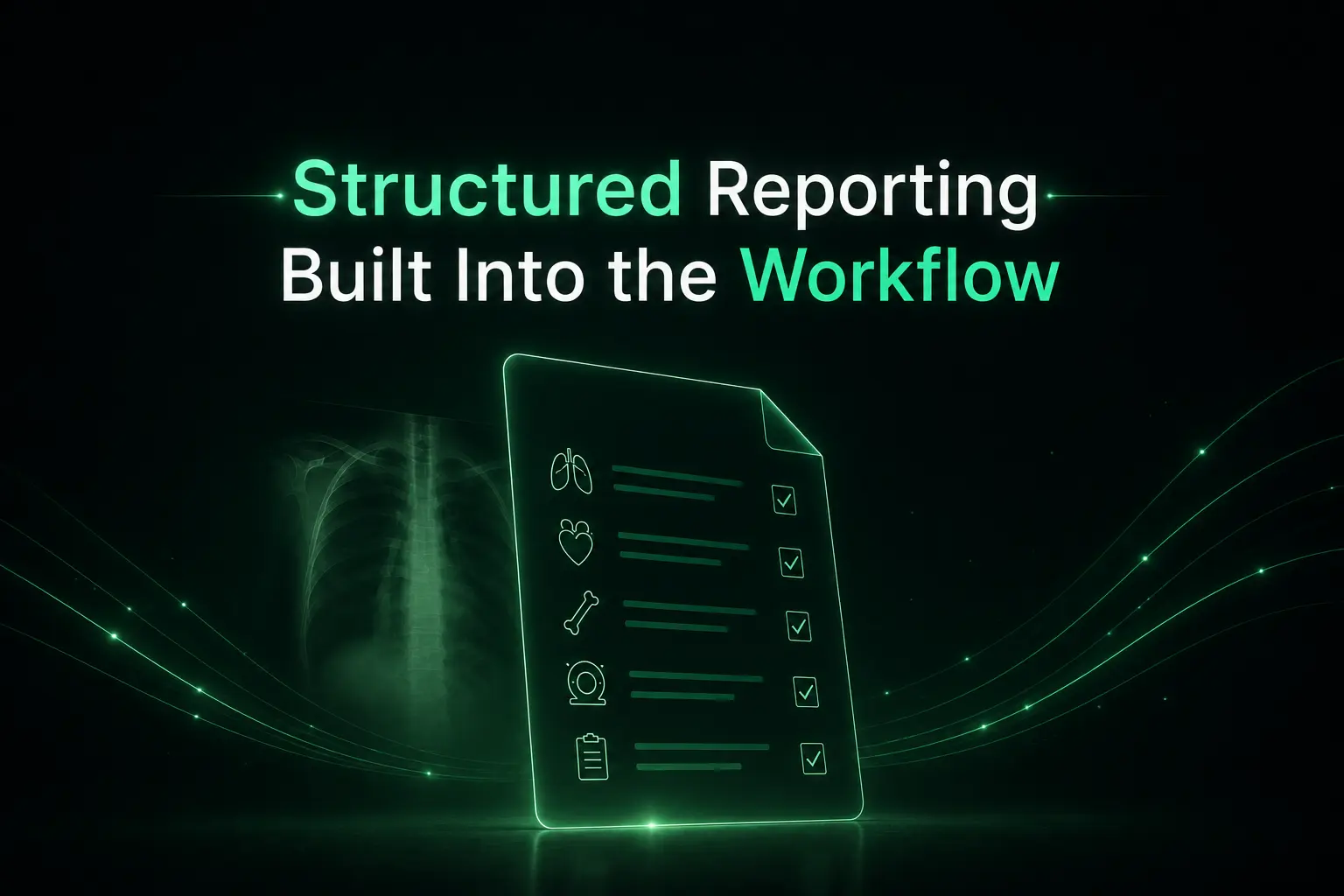
Structured radiology reporting — the practice of generating reports in a consistent, organised format that makes findings immediately actionable for referring clinicians — has been an aspirational standard for years. In practice, maintaining it across high-volume teleradiology environments has been difficult.

AI changes this equation. Voice-driven AI reporting tools — such as RadNeo, developed by UEVOLVEAi — allow radiologists to dictate their findings naturally as they review a scan. The system converts speech into structured, clinically relevant report drafts in real time — organising findings, applying appropriate terminology, and formatting the output for consistency.

The radiologist reviews, refines, and finalises the report. The AI handles the structural work. The result is faster report generation, greater consistency across the team, and significantly reduced documentation burden on the radiologist.

3. Automated Comparative Analysis

Effective radiology interpretation frequently requires comparing the current study against prior imaging. In traditional workflows, pulling prior studies requires manual retrieval — a step that adds time and introduces the risk that relevant prior imaging is missed entirely.

AI-powered comparative analysis automates this entirely. The system identifies prior studies for the same patient, aligns current and prior images, and highlights meaningful interval changes for the radiologist's review. What previously required manual retrieval now happens automatically, without the radiologist leaving the current study.

4. Knowledge Graph–Driven Clinical Intelligence

The most sophisticated AI systems in radiology are moving beyond pattern recognition toward something more structured: radiology knowledge graphs.

Rather than simply generating text outputs, knowledge graph–driven systems build a structured representation of radiology intelligence — anatomical relationships, pathological patterns, clinical context — that informs every report. This is the difference between AI that transcribes what a radiologist says and AI that understands what the findings mean clinically.

The practical outcome is reports that are not just faster, but more contextually accurate — with less variation between individual radiologists and a lower risk of clinically significant findings being underemphasised in the final report.

5. Seamless PACS Integration

One of the most common concerns about AI in radiology has been disruption to existing infrastructure. Most hospitals and teleradiology operations have significant investment in their PACS systems, their RIS workflows, and their reporting templates.

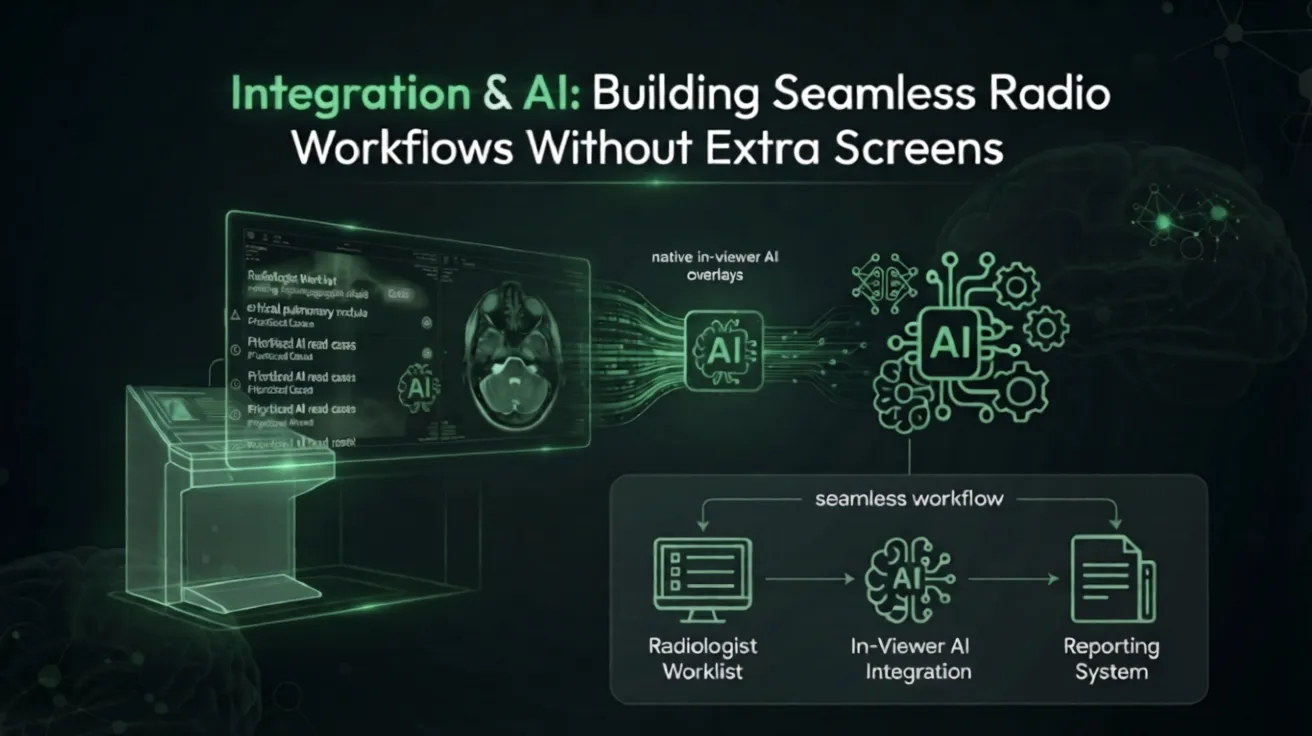
The AI systems gaining traction in 2026 are those designed to work within existing infrastructure — not alongside it as a separate tool requiring an additional screen or login. Workflow-embedded AI operates inside the radiologist's existing PACS environment, adding intelligence to the workflow the radiologist already uses rather than asking them to adopt an entirely new system.

This is the design philosophy behind RadNeo: no switching, no disruption — just a smarter version of the workflow already in place.

6. Agentic AI: The Emerging Frontier

Beyond the tools currently in clinical deployment, a more ambitious category of AI is beginning to enter radiology: agentic AI systems.

Agentic AI refers to systems that do not simply respond to inputs — they reason, plan, and take actions within a workflow without requiring explicit instruction at each step. In a radiology context, an agentic system does not just draft a report when a radiologist dictates findings; it monitors the worklist, identifies which studies need attention, retrieves relevant prior imaging, flags critical findings proactively, and structures the report — all within the flow of the radiologist's working session.

Agentic AI in radiology is the shift from AI as a tool the radiologist uses to AI as a system that works alongside the radiologist — adapting to what is needed in real time.

This distinction has significant implications for teleradiology at scale. A teleradiology operation reading thousands of studies per week across a distributed radiologist network needs AI that does not require a separate action for every workflow decision. It needs AI that manages the workflow intelligently — surfacing the right information, at the right time, without cognitive overhead.

What the Evidence Shows

The clinical case for AI in radiology is now well-supported by published research:

These are not projections about what AI might eventually deliver. They reflect what is being measured in clinical environments today.

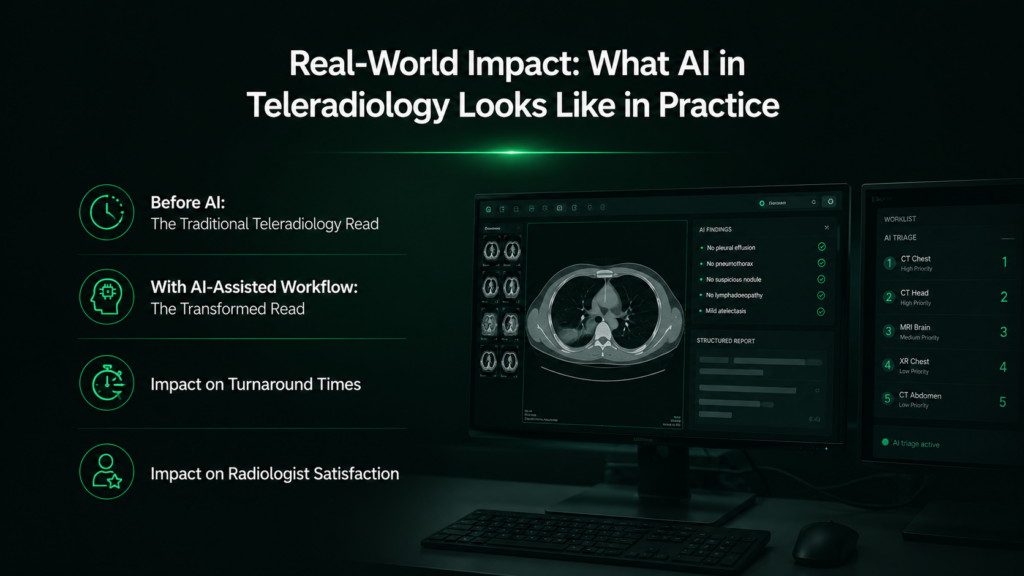
Real-World Impact: What AI in Teleradiology Looks Like in Practice

It is one thing to cite efficiency metrics. It is another to understand what the change looks like inside a working teleradiology environment. Here are the concrete operational differences AI makes in practice:

Before AI: The Traditional Teleradiology Read

A radiologist opens a CT chest study. They manually locate prior imaging in a separate PACS window. They dictate into a speech recognition system, which transcribes their words with variable accuracy. They correct transcription errors manually. They format the report to match facility requirements. They sign the report and move to the next study. Across 80 studies in a shift, the administrative overhead is significant.

With AI-Assisted Workflow: The Transformed Read

The same CT chest study arrives at the top of the worklist — already prioritised by the AI triage system based on clinical urgency signals. Prior imaging has been automatically retrieved and aligned. A preliminary structured report draft is pre-populated with AI-identified findings for the radiologist to review. The radiologist dictates naturally using voice commands; the AI formats and structures output in real time. Corrections are minimal. The report is signed and the next study is already queued. Across 80 studies in a shift, the radiologist has spent significantly more time on clinical interpretation and less time on documentation overhead.

The radiologist's expertise doesn't change. Their capacity does. That is what AI workflow intelligence delivers — more of the right work, less of the overhead.

Impact on Turnaround Times

The same CT chest study arrives at the top of the worklist — already prioritised by the AI triage system based on clinical urgency signals. Prior imaging has been automatically retrieved and aligned. A preliminary structured report draft is pre-populated with AI-identified findings for the radiologist to review. The radiologist dictates naturally using voice commands; the AI formats and structures output in real time. Corrections are minimal. The report is signed and the next study is already queued. Across 80 studies in a shift, the radiologist has spent significantly more time on clinical interpretation and less time on documentation overhead.

The radiologist's expertise doesn't change. Their capacity does. That is what AI workflow intelligence delivers — more of the right work, less of the overhead.

Impact on Radiologist Satisfaction

Radiologist burnout is one of the most significant retention challenges in modern radiology. The 2025 Philips Future Health Index found that 43% of radiologists spend more time on administrative tasks than they did five years ago. AI workflow tools directly address this — reducing documentation burden and giving radiologists more time for the clinical work that drew them to the specialty in the first place.

How to Evaluate AI in Teleradiology: A Framework for Healthcare Leaders

Teleradiology pricing varies by provider, coverage model, read volume, and subspecialty requirements. Understanding the cost structure is important for healthcare leaders evaluating a teleradiology partner.

1. Does the AI work inside existing systems or require a separate platform?

The single most important operational question. AI that requires radiologists to switch between systems, log in to separate platforms, or manage a parallel workflow adds cognitive burden rather than reducing it. Genuine workflow AI operates inside the PACS and reporting environment radiologists already use.

2. Is the AI clinically validated or commercially validated?

There is a significant difference between AI systems that have demonstrated clinical accuracy improvements in peer-reviewed studies and AI systems that have been optimised for commercial demonstration scenarios. Insist on published clinical validation data — accuracy rates, sensitivity, specificity, and comparative studies against baseline performance.

3. Who is accountable for the final report?

AI can assist, but clinical accountability must remain with a board-certified radiologist. Any AI platform that positions itself as a replacement for the radiologist's sign-off — rather than a support for it — introduces unacceptable clinical and regulatory risk. Every final report must be reviewed and signed by a credentialed radiologist.

4. How does the AI handle edge cases and rare presentations?

AI systems trained on majority-population datasets can underperform on rare presentations, unusual anatomy, or low-prevalence conditions. Understanding how a platform handles cases that fall outside its training distribution — and whether it flags uncertainty appropriately — is critical for clinical deployment.

5. What does integration actually involve?

Some AI vendors significantly understate integration complexity. Before committing to a platform, get a clear, technical answer on PACS compatibility, data exchange protocols, HL7 FHIR support, and the IT resources required for deployment. Platforms that require months of implementation and ongoing technical support carry hidden costs.

The best AI in teleradiology is the AI you never have to think about — because it works inside the systems you already use, improves the workflow you already have, and delivers its value without asking for a separate action.

What AI in Teleradiology Does Not Do

There is an important distinction that often gets lost in discussions of AI in radiology: AI does not replace radiologists.

Every final teleradiology report is signed by a board-certified radiologist who is accountable for the diagnostic conclusion. AI handles the workflow — triage, structuring, comparative analysis, preliminary flagging — and the radiologist handles the clinical interpretation and final report sign-off.

The value of AI in teleradiology is not the elimination of the radiologist. It is the elimination of everything that prevents the radiologist from focusing on what only a radiologist can do.

When AI handles the documentation, the triaging, the formatting, and the retrieval — the radiologist gets to be a radiologist. That is the workflow transformation that actually matters.

What This Means for Hospitals and Imaging Centers

For hospital radiology departments and imaging centers evaluating teleradiology partnerships in 2026, the presence or absence of AI-integrated workflow capability is now a meaningful differentiator — not a bonus feature.

A teleradiology partner without AI-assisted workflow tools is asking their radiologist team to sustain high-volume, high-quality reporting on infrastructure that was not designed for current scan volumes. The operational consequences are predictable: slower turnaround times, higher radiologist fatigue, greater reporting variability, and increasing difficulty retaining experienced radiologists.

A teleradiology partner with genuinely embedded AI workflow intelligence — triage, voice reporting, structured outputs, comparative analysis, PACS integration — delivers something fundamentally different: a system where the AI absorbs the operational overhead and the radiologist delivers the clinical precision.

Why Choose UEVOLVEAi for AI-Powered Teleradiology?

The teleradiology market is at an inflection point. Three forces are converging simultaneously: a widening radiologist workforce shortfall, a rapid expansion of FDA-cleared AI tools for medical imaging — now surpassing 1,000 cleared devices — and the structural normalisation of remote radiology work post-pandemic.

The facilities that will deliver the best patient outcomes over the next five years are those that partner with teleradiology providers that have successfully embedded AI into every stage of the clinical workflow — not as an optional feature, but as the default operating infrastructure.

AI in teleradiology is not about replacing radiologists. It is about giving every radiologist access to a system that triages their worklist, flags what is urgent, and generates the first draft of their report — so they can focus entirely on the clinical interpretation that matters.

Why Choose UEVOLVEAi for Teleradiology?

The healthcare technology market in 2026 is saturated with AI tools claiming to transform radiology. Most were built by technology companies that began with the AI and looked for a radiology problem to solve. UEVOLVEAi was built the other way around.

We started inside reporting rooms — working with radiologists to understand the real daily friction points in their workflow — and built technology to solve those problems specifically. The result is an AI-powered teleradiology platform where every feature exists because a working radiologist needed it.

UEVOLVEAi is not AI added to teleradiology. It is teleradiology rebuilt around AI — designed from the inside out for the way radiologists actually work.  

To see RadNeo in action and learn how UEVOLVEAi’s AI-powered workflow intelligence can transform your teleradiology operation, request a demo or contact our team today.

Frequently Asked Questions

Does AI replace radiologists in teleradiology?

No. AI assists radiologists by handling workflow tasks — triage, report structuring, comparative analysis, critical finding flagging — but every final teleradiology report is reviewed and signed by a board-certified radiologist. The clinical accountability remains with the radiologist.

What is structured radiology reporting and why does AI matter for it?

Structured radiology reporting is the practice of organising radiology reports in a consistent, standardised format that makes clinical findings immediately clear and actionable for referring physicians. AI makes structured reporting achievable at scale by automatically organising the radiologist's dictated findings into the appropriate format — without requiring additional manual formatting time.

What is the difference between AI-assisted teleradiology and traditional teleradiology?

Traditional teleradiology moves images from the facility to the radiologist and returns the report. AI-assisted teleradiology adds an intelligent layer to every stage of that workflow — triaging the worklist by urgency, flagging critical findings before the radiologist opens the study, generating a preliminary structured report draft, and automating comparative analysis. The radiologist still interprets the images and signs every report; the AI handles the operational infrastructure around that interpretation.

What is agentic AI in radiology?

Agentic AI refers to systems that reason and act within a workflow autonomously — rather than only responding when prompted. In radiology, agentic AI can monitor the worklist, retrieve prior studies, triage urgency, and structure the reporting environment without requiring explicit instruction at each step. It operates as an active participant in the radiologist's workflow, not just a passive tool.

How does AI integrate with PACS systems in teleradiology?

The best AI systems in teleradiology are designed to integrate directly within existing PACS infrastructure — so the radiologist sees AI-generated insights, preliminary reports, and flagged findings within the same interface they already use. There is no separate login, no additional screen, and no disruption to the existing workflow.

How do I evaluate whether an AI teleradiology platform is clinically validated?

Ask for peer-reviewed published studies demonstrating accuracy, sensitivity, and specificity — not just internal benchmarks or commercial case studies. Validated AI platforms will have measurable clinical evidence. Also look for FDA clearance for specific intended uses, integration with ACR standards, and transparency about model limitations and edge-case performance.

Conclusion

The transformation of teleradiology by AI is not a future event. It is happening now, across radiology departments, teleradiology operations, and imaging centers worldwide.

The facilities and teleradiology providers that will deliver the best clinical outcomes over the next five years are those that have understood a fundamental truth: the challenge in radiology was never the quality of the radiologists. It was the workflow surrounding them. AI is solving that problem — and the practices, hospitals, and imaging operations that partner with AI-native teleradiology providers in 2026 will have a structural advantage that only grows over time.