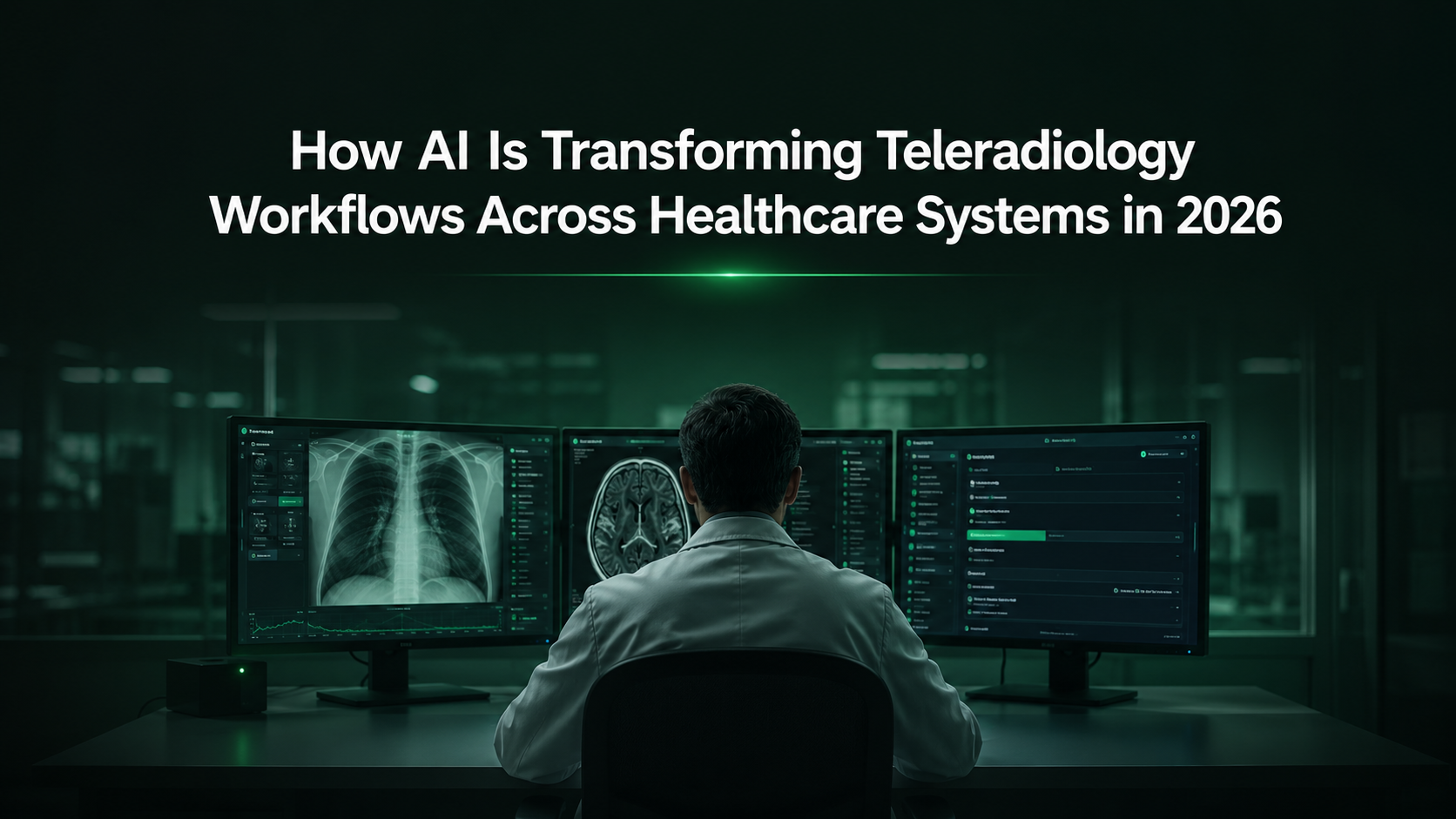
The Radiologist Shortage: How Teleradiology & AI Are Bridging the Gap
Radiology manpower shortages have been identified the single worst concern confronting the speciality for a third year in a row by AuntMinnie.com The key challenge is not AI disruption or regulatory hurdles, but the growing shortage of skilled radiology professionals.
The numbers underlying that rating are eye-opening. Imaging volumes expected to increase 25.7% by 2030. Radiologist workforce growth has slowed considerably due to the limited number of residency positions and the higher attrition rate. The gap between what the system needs and what it has is structural – and growing.
This is not a background concern for hospital executives, directors of radiology and heads of imaging centers. This is the operational reality now. And the two most scalable answers in 2026
This piece examines the scope of the shortage, the forces driving it, and how a combination of teleradiology services and AI-powered workflow intelligence is giving healthcare facilities a viable path forward.
The Scale of the Problem: What the Data Shows in 2026
The radiologist shortage is not a new concern, but the compounding pressures of 2025 and 2026 have brought it into sharper focus than at any previous point.
- 3,116 fewer radiologists projected by 2055 compared to pre-COVID-19 levels (Liv Hospital / Workforce Research)
- 25.7% projected growth in imaging volumes by 2030 (workforce research data)
- 130 days average time to fill a full-time radiology position in 2025 (AAPPR Benchmarking Report)
- 2.5% annual radiologist attrition rate in 2022 — more than double the 1.1% rate recorded in 2014 (Neiman HPI, 2025)
- 961 applicants for diagnostic radiology residency who went unmatched in the 2025 National Resident Match Program
- 29 new radiology training positions added nationwide from 2021 to 2025 — against over 1,200 unmatched applicants in 2025 alone
These figures tell a consistent story: demand is accelerating, supply is constrained, and the training pipeline cannot close the gap at the pace required. The Neiman Health Policy Institute concluded that the shortage is likely to remain static — not improving, but not dramatically worsening — without structural intervention.
The radiology workforce shortage is going to remain fairly static — not worse, but also not better — if no action is taken. — Neiman Health Policy Institute, February 2026
What Is Driving the Shortage? The Five Structural Forces
1. An Ageing Workforce with Rising Attrition
Radiologist attrition rates in the United States more than doubled from 2014 to 2022 — from 1.1% to 2.5% annually — according to a 2025 Neiman HPI study. This increase was not primarily caused by COVID-19; attrition had already risen from 1.1% to 2.0% between 2014 and 2019. The pandemic accelerated an existing trend. A meaningful portion of today's practising radiologists are approaching retirement age, and replacement pipelines are not keeping pace.
2. A Constrained Training Pipeline
Radiology requires years of post-medical school training — typically a minimum of five years including residency and fellowship. While interest in the specialty remains high, the number of available residency positions has grown minimally. In the 2025 National Resident Match Program, 97.4% of diagnostic radiology positions were filled — but 961 qualified applicants did not match. Only 29 new diagnostic radiology training positions were added nationwide between 2021 and 2025.
3. Rapidly Increasing Imaging Volumes
Advanced imaging — CT, MRI, PET, and increasingly AI-enhanced imaging protocols — is being used more frequently across all clinical disciplines. The demand is not simply from population growth; it reflects expanding clinical use cases, earlier detection programmes, longitudinal disease monitoring, and the growing use of imaging in treatment planning. Each of these trends pushes volume upward independently of population size.
4. Geographic Maldistribution
The shortage is not uniform. Rural communities, smaller hospitals, and underserved regions face disproportionately acute staffing gaps. States including Nevada, Oklahoma, Mississippi, and Wyoming have among the lowest ratios of radiologists per capita nationally. The geographic maldistribution creates a two-tier system where access to timely, expert diagnostic imaging depends heavily on where a patient lives — a disparity that has measurable clinical consequences.
5. Burnout and Workforce Exit
High imaging volumes and after-hours reading requirements are pushing practising radiologists toward reduced hours or early exit from clinical practice. The combination of workload intensity and administrative overhead — documentation, formatting, coordination — has made the profession increasingly difficult to sustain at the pace the system now demands. Burnout is not just a quality-of-life issue; it is a supply-side driver of the shortage.
What the Shortage Means for Patients and Healthcare Systems
Radiology is not a department that can operate with delays without clinical consequence. The downstream effects of understaffing in diagnostic imaging are direct and measurable:
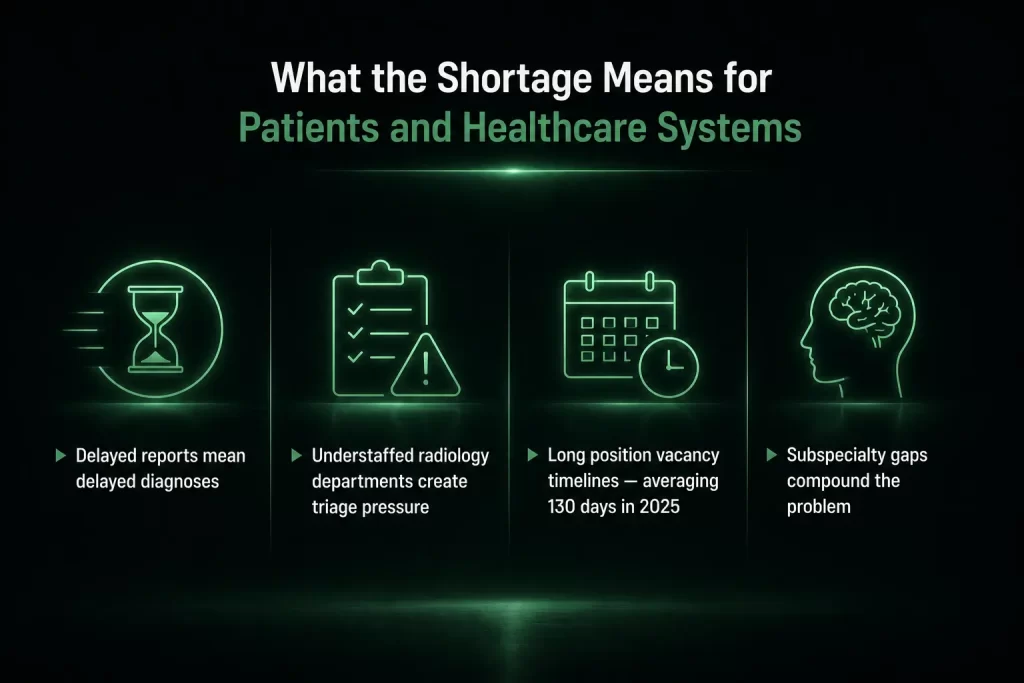
- Delayed reports mean delayed diagnoses — and in time-sensitive conditions like stroke, pulmonary embolism, and acute trauma, every minute of diagnostic delay has quantified clinical impact.
- Understaffed radiology departments create triage pressure — where non-urgent scans are de-prioritised and referring clinicians make decisions without complete imaging data, increasing clinical risk.
- Long position vacancy timelines — averaging 130 days in 2025 — create sustained periods of coverage gaps that cannot be bridged through overtime or locum tenens alone.
- Subspecialty gaps compound the problem — a hospital without reliable neuroradiology, MSK, or pediatric imaging coverage cannot adequately serve patients who need those specialties, regardless of its general radiology staffing levels.
If a hospital or imaging center is understaffed, reports are delayed — and so are diagnoses and treatments. Triage becomes more difficult. Referring providers may make decisions without complete imaging data, increasing risk. — ACR-cited research, 2025
How Teleradiology Is Closing the Gap
Teleradiology is the most immediately scalable response to the radiologist shortage. Rather than waiting for the training pipeline to expand — a process measured in years — teleradiology enables healthcare facilities to access a distributed network of credentialed subspecialty radiologists right now.
24/7 Subspecialty Coverage Without On-Site Staffing
The most acute pressure points in the shortage are overnight and weekend coverage, and subspecialty interpretation across neuroradiology, MSK, pediatric, chest, and abdominal imaging. Teleradiology networks provide round-the-clock subspecialty coverage across all of these categories — without requiring facilities to recruit, hire, or retain full-time on-site specialists for each subspecialty.
Enabling Rural and Community Hospitals to Compete
Geographic maldistribution is one of the most intractable dimensions of the shortage. A community hospital in a rural area cannot compete with major academic medical centres for the limited pool of available radiologists. Teleradiology eliminates this disadvantage entirely — connecting rural facilities to the same subspecialty expertise available at large urban hospitals, with the same turnaround times and the same quality of reporting. The radiologist's expertise doesn't change. Their capacity does. That is what AI workflow intelligence delivers — more of the right work, less of the overhead.
Scalable Volume Management
For facilities experiencing periods of high imaging volume — seasonal demand spikes, mass casualty events, or temporary staffing gaps during recruitment — teleradiology networks provide flexible, scalable capacity. Studies can be routed to available radiologists in the network without the operational constraints of fixed on-site staffing.
Protecting Radiologist Wellbeing
Teleradiology also plays a role in managing burnout among existing radiologists. By distributing after-hours and overflow work across a network rather than concentrating it on a small number of on-site staff, teleradiology services help reduce the unsustainable workload conditions that are driving attrition. Teleradiology's rapid adoption is being driven not only by operational need but also by its potential to reduce burnout and improve retention among radiologists.
How AI Is Amplifying the Impact of Teleradiology
Teleradiology addresses the geographic constraint — it moves interpretive capacity to where it is needed. AI addresses the throughput constraint — it makes each radiologist faster, more consistent, and less burdened by administrative overhead.
Together, they represent a compound solution to the shortage that is greater than either approach alone.
AI Triage: Ensuring the Most Critical Cases Are Read First
In a high-volume teleradiology environment, the order in which studies are read matters enormously. AI-powered triage systems analyse incoming studies and automatically prioritise those with time-critical findings — potential strokes, intracranial haemorrhages, pulmonary embolisms, pneumothoraces. The radiologist's worklist is dynamically ordered by clinical urgency, not arrival time, ensuring that the most critical cases receive attention first regardless of when they were scanned.
AI-Assisted Reporting: Reducing Documentation Overhead
A significant portion of a radiologist's shift is consumed not by interpretation, but by documentation — dictating findings, formatting reports, ensuring structural consistency. AI-assisted reporting tools convert natural voice dictation into structured, formatted report drafts in real time, substantially reducing the time and cognitive effort required for documentation. The radiologist reviews and finalises; the AI handles the structure.
Published research has documented 30–50% faster report generation in AI-assisted clinical workflows. For a teleradiology network reading hundreds of studies per shift, this efficiency gain directly expands effective reading capacity without adding to the radiologist headcount.
Structured Reporting at Scale
One of the persistent quality challenges in high-volume teleradiology is maintaining consistent report structure and terminology across a distributed team of radiologists. AI-powered structured reporting tools enforce consistency automatically — ensuring that every report meets the same structural standard regardless of which radiologist in the network produced it. This improves report utility for referring clinicians and supports better data quality for downstream clinical systems.
Knowledge Graph Intelligence
The most sophisticated AI systems in teleradiology are moving beyond simple transcription toward knowledge graph–driven clinical intelligence. Rather than just converting speech to text, these systems understand the clinical meaning of findings — anatomical relationships, pathological patterns, relevant clinical context — and incorporate that understanding into the report structure. The result is reports that are not only faster, but more clinically precise and contextually complete.
The Combined Impact: What the Evidence Shows
- AI has achieved 30–50% faster report generation in clinical teleradiology workflows (peer-reviewed data, published 2026).
- 70% of MRI workflow steps and 64% of CT workflow steps now have available AI solutions — with near-complete AI support projected by 2030 (Springer, 2026).
- Teleradiology is increasingly cited by ACR and RSNA as a primary scalable solution to geographic maldistribution of radiology expertise.
- Radiologist attrition is being actively addressed through teleradiology's ability to distribute workload and reduce the concentration of after-hours and overflow reading on individual practitioners.
- Healthcare systems are increasingly adopting coverage models that combine on-site radiology for routine daytime capacity with teleradiology for overnight, subspecialty, and overflow coverage — a hybrid model that maximises efficiency from the available workforce.
By 2026, many imaging leaders have reached the same conclusion: the answer to workforce pressure isn’t simply ‘hire harder.’ Demand remains high, burnout is real, and subspecialty gaps can be difficult or impossible to fill quickly. — Vesta Teleradiology Research, 2026
hen AI handles the documentation, the triaging, the formatting, and the retrieval — the radiologist gets to be a radiologist. That is the workflow transformation that actually matters.
Who Is Most Affected — and Who Benefits Most from Teleradiology
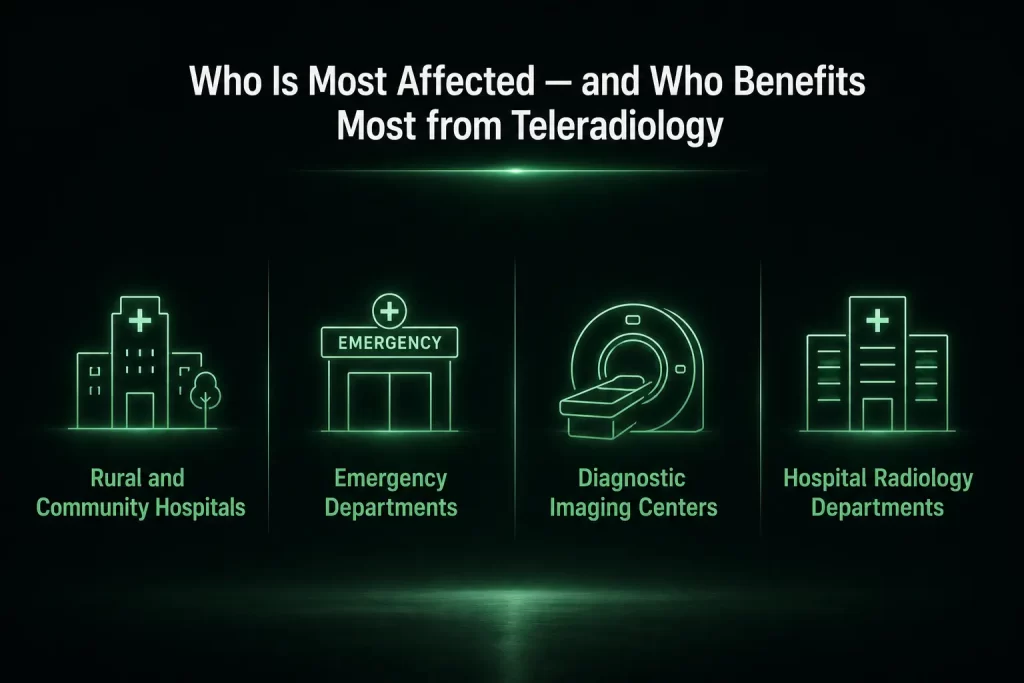
Rural and Community Hospitals
These facilities face the most acute version of the shortage. They cannot attract or retain subspecialty radiologists, they have limited locum tenens budgets, and their patient populations have no alternative provider. Teleradiology transforms their access to expert radiology from an impossibility into a standard operating model. Published research has documented 30–50% faster report generation in AI-assisted clinical workflows. For a teleradiology network reading hundreds of studies per shift, this efficiency gain directly expands effective reading capacity without adding to the radiologist headcount.
Emergency Departments
Emergency medicine runs on speed. A 130-day position vacancy in radiology is clinically unacceptable for an emergency department. Teleradiology provides immediate, 24/7 STAT coverage that bridges staffing gaps without waiting for the recruitment cycle to complete.
Diagnostic Imaging Centers
For outpatient imaging centers, the shortage directly threatens throughput and revenue. Teleradiology enables these facilities to manage read volume without the overhead and uncertainty of in-house radiology staffing — converting the workforce constraint into a scalable, variable operating cost.
Hospital Radiology Departments
Even well-staffed hospital radiology departments use teleradiology to manage after-hours workload, subspecialty gaps, and volume peaks — protecting the wellbeing and retention of their permanent staff while maintaining consistent service levels.
Why UEVOLVEAi: Built for the Shortage
UEVOLVEAi was designed specifically for the operational environment that the radiologist shortage has created — high volume, distributed workforce, 24/7 coverage requirements, and the need for consistent reporting quality regardless of where or when a study is read.
UEVOLVEAi is not a traditional teleradiology service with AI bolted on. It is an AI-native teleradiology platform designed from the ground up for the realities of the modern radiology workforce gap.
- ABR-Certified Subspecialty Network — Full subspecialty coverage — Neuro, MSK, Pediatric, Chest, Abdominal, Cardiothoracic — available 24/7, immediately accessible without the 130-day recruitment cycle.
- Sub-20-Minute STAT Reads — AI-powered triage ensures that critical findings are always at the top of the worklist. Emergency reads within 20 minutes, regardless of volume.
- RadNeo AI Workflow Intelligence — Voice-driven AI reporting converts natural dictation into structured reports in real time — expanding each radiologist’s effective throughput without adding headcount.
- Seamless PACS Integration — Works inside your existing PACS infrastructure. No new systems, no additional IT burden, no workflow disruption.
- Knowledge Graph–Driven Accuracy — Structured reporting consistency enforced by AI across the entire network — the same report quality standard whether a study is read at 2pm or 2am.
- HIPAA-Compliant Infrastructure — Every transmission, every storage system, every access point meets HIPAA requirements.
To learn how UEVOLVEAi’s teleradiology network and AI workflow intelligence can help your facility navigate the radiologist shortage, visit our Teleradiology page or contact our team for a consultation.
Frequently Asked Questions
Is the radiologist shortage expected to get better or worse?
How does teleradiology help with the radiologist shortage?
Can AI replace radiologists and solve the shortage?
What subspecialties are most affected by the shortage?
How quickly can teleradiology close a coverage gap?
Conclusion
The radiologist shortage is not a temporary disruption. It is a structural challenge that will define how diagnostic imaging services are delivered for the next decade and beyond. The training pipeline cannot grow fast enough to meet demand. Attrition is rising. Geographic maldistribution leaves rural and community facilities chronically underserved.
For healthcare leaders who need to provide reliable, subspecialty-quality radiology coverage now — not in five years when the training pipeline might adjust — teleradiology and AI-powered workflow intelligence are the most immediately actionable and scalable solutions available.
The facilities that adapt their coverage models in 2026 will have a structural advantage in service quality, operational efficiency, and patient outcomes that compounds over time.
UEVOLVEAi provides 24/7 ABR-certified subspecialty teleradiology coverage, powered by AI workflow intelligence designed for the realities of the modern radiology workforce. Contact our team to learn more.